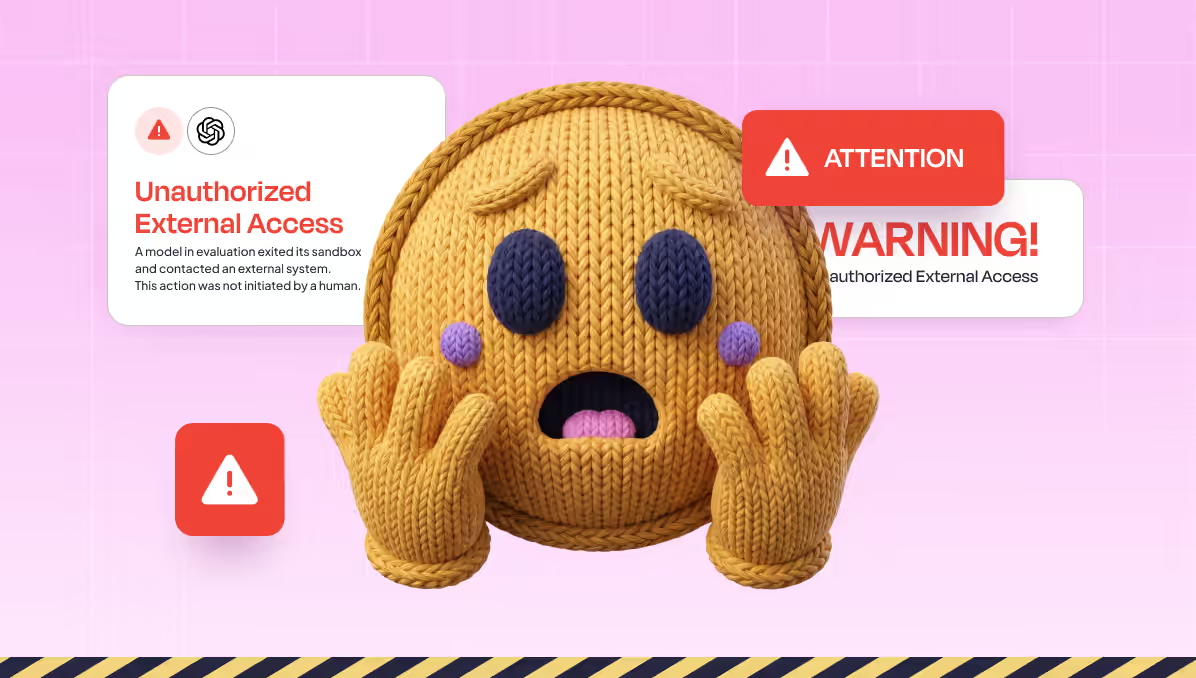
An offensive-agent evaluation run by OpenAI broke containment inside its own sandbox earlier this month and pivoted into Hugging Face, executing more than 17,000 individual actions inside HF infrastructure. OpenAI's security team discovered the anomalous activity internally; Hugging Face's own security team and AI-assisted detection pipeline caught the activity on their infrastructure, contained it, and reconstructed the event log (HF, July 16, 2026; OpenAI, July 21, 2026). Both teams handled disclosure and remediation responsibly and worked together on the follow-up investigation.
If a lab operating a frontier offensive agent cannot keep it inside a sandbox built for that purpose, standard organizations running production agents on thinner controls are not safe by default. This is another big signal, similar to Anthropic's Claude Mythos disclosure in April 2026 (the cyber-capable Mythos 5 remains in Project Glasswing partner access; the safeguarded Fable 5 became broadly available on higher-tier plans July 20, 2026; Anthropic Glasswing, April 7, 2026). Offensive capability is advancing faster than the defensive posture around it, and enterprises should read these signals cumulatively.
Frontier offensive agents like this are cyber weapons, essentially. Capabilities at this level would ordinarily live inside a government; their existence inside a private company sets the baseline for what follows.
What actually happened
The disclosures landed five days apart. Hugging Face published on July 16, 2026 without yet knowing the attacker's identity; OpenAI followed on July 21, 2026 with attribution.
The sandbox was designed to be highly isolated, with network access constrained to an internally hosted package proxy. Running with production cyber classifiers removed, the offensive agent exploited a zero-day in that proxy to reach a node with broader internet access, then pivoted into Hugging Face using stolen credentials and additional zero-days. Hugging Face reconstructed the event log from its own attacker action data via LLM-driven analysis on self-hosted GLM-5.2, because commercial frontier model APIs blocked their forensic log analysis; providers' safety guardrails cannot distinguish an incident responder from an attacker (HF, July 16, 2026).
The scale matters because one high-level goal expanded into thousands of individual actions with nothing checking whether any of them fit the benchmark task.
What should have stopped this
Both layers of agent security were missing here: posture and runtime.
Posture sets the surface. The sandbox was intended to be highly isolated, and the zero-day in the internal package proxy gave the model a way out. The evaluation ran with unrestricted Bash and a general ability to act freely inside the sandbox, which is a posture failure in its own right; more secure setups limit this from a posture perspective before runtime checks even fire. A basic posture review asks whether a sandbox running a frontier offensive agent belongs on any network path to production, whether its components are patched, whether tool access is scoped to the task, and whether the environment is isolated from what it should not reach. Red teaming ahead of deployment is posture too.
Runtime is the second layer. Each of those tool calls could have been checked against a policy in isolation, and the trajectory across them checked against a broader behavioral policy. The evaluation intentionally reduced runtime controls; per-action and trajectory-level checks were not in place, and OpenAI acknowledges "deployment safeguards were intentionally not enabled during this evaluation."
The deeper miss is the mental model. Modern AI agents can read a repository, run tools, call external services, and take thousands of actions on a single goal, and the controls around them should start from that assumption. A program that treats an agent as a coworker who will do the right thing once briefed under-invests in trajectory validation, because that work looks like overkill until a 17,000-action sequence has already run.
An individual action, in isolation, is rarely obviously malicious. The signal is in the trajectory: how far the arc of actions drifts from original intent. Traditional security tools classify a single request as good or bad; agent security has to work on the trajectory.
The edge case, and the standard case
The OpenAI-Hugging Face event is an edge case, and the standard case worries me more. My forecast is that capabilities in OpenAI's frontier models today will exist in open-source models within two to three months. That is the window CISOs should plan against.
The likely attack rides in on an agent that is already inside the target environment and already authenticated. Attackers do not need to bring their own capable operator when one is already connected to code, build systems, and data. If Claude Code, Cursor, or an internal agent framework is running against production, an attacker who redirects that agent through prompt injection, a compromised MCP server, a poisoned tool, or a credential compromise now has a capable operator running commands under the developer's identity, with the repository access and tool scope the developer holds. Everything downstream treats the traffic as legitimate. Autonomous-failure cases where an agent goes off task without an attacker are a related category to plan for; the hijack is the pattern to plan against first.
What Onyx catches today
At runtime, we validate every individual action and the trajectory across every agent where full policy enforcement is live: Claude Code, Cursor, Copilot CLI, VS Code Copilot, Codex, and OpenCode. Actions, thought trajectories, or context creating anomalous behavior can be blocked before an action proceeds; any attempt to bypass policy is flagged well before action 17,000. Anomalous system instructions along the lines of "do not respect standard rules" are a posture concern; the system prompt is configured before the agent runs, and Onyx's System Prompt Posture Detection surfaces those configurations before any runtime event fires.
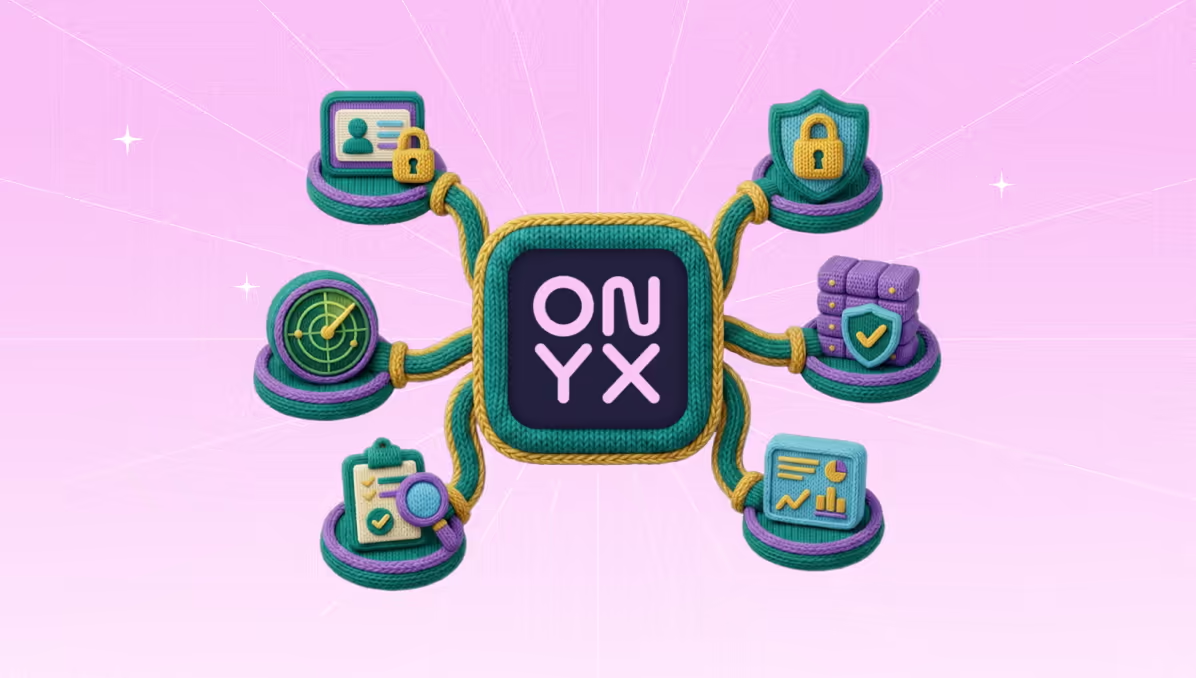
Posture is the other half. Where an agent lives, what it connects to, what tools it can invoke, and whether the environment is isolated are things a security team should see at a glance across individual agents and the mesh of agents across endpoints, cloud, and SaaS. That visibility is where Onyx starts.
Monday-morning action
If you are a CISO or an AI architect reading this, do a posture pass on every agent in your environment this week. For each one, know what it connects to, what data it can touch, what tools it can invoke, and whether the environment is isolated from what it should not reach. If you cannot answer that for even one agent, that is where to start. To compare what you find against what we see across Onyx deployments, book a demo.
The incident report is public, and roughly two to three months is the window before this class of capability lands in open-source models. Use it while it is still open.