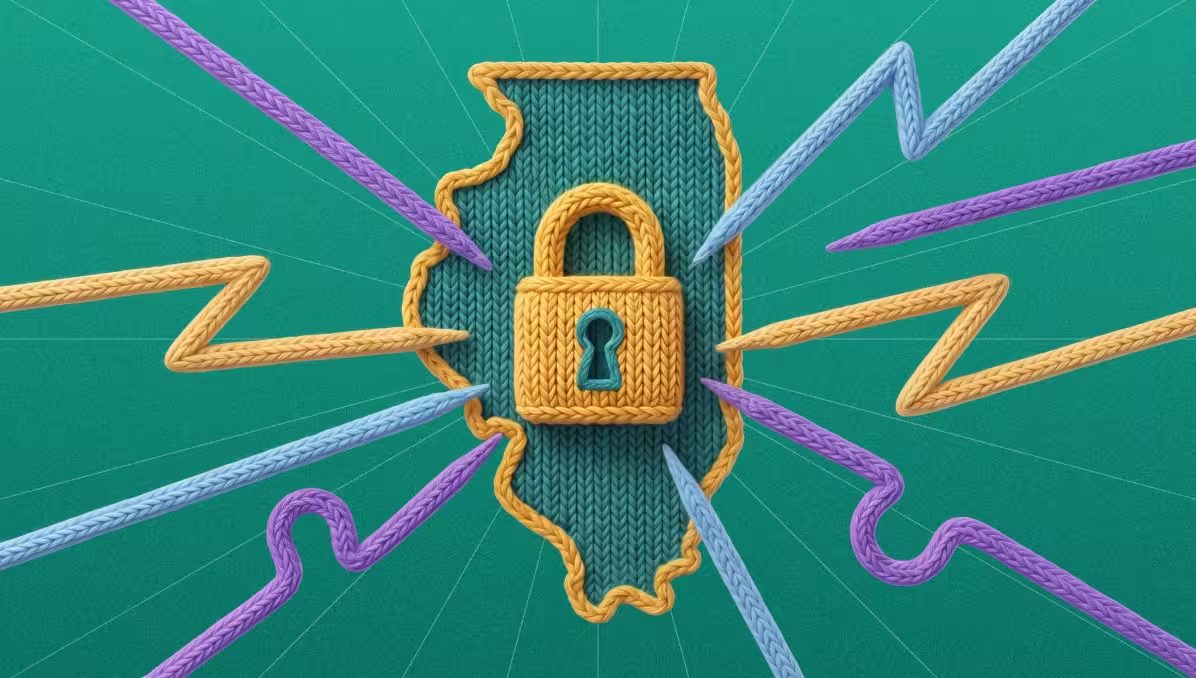
On July 6, Governor Pritzker signed the Illinois Artificial Intelligence Safety Measures Act, SB 315. The bill takes effect January 1, 2027, and it does something no state has done before: it requires independent third-party safety audits of the largest frontier AI systems. Not self-attestation. Not vendor promises. Independent verification, by qualified experts, on the systems shaping how we work.
That is a real accomplishment. California and New York have adjacent frameworks. Illinois goes further. Anthropic publicly supported the bill. I expect other frontier developers to follow, either because they agree with the framing or because the regulatory pressure makes it hard not to.
But here is what SB 315 does not do. It does not solve the problem most enterprises actually have.
The gap SB 315 does not close
SB 315 governs the developers of the largest advanced AI systems. The frontier labs. The people training the models the rest of us build on.
The enterprise problem sits one layer up. It is not that this quarter's frontier model might behave dangerously in a lab benchmark. It is that a coding agent on a developer laptop, a Copilot Studio agent inside a business unit, or an MCP server installed from a public registry is now taking action on behalf of a real employee, against real data, with real credentials.
The security event is the agent's decision, not the model's response. And no frontier-lab audit report is going to tell you what your Bedrock agent did with your customer data at 2:14 PM on a Tuesday.
Why the enterprise-agent layer needs its own answer
I spent thirty years as a CISO. Four Fortune 500 first-CISO roles. What I learned across all of them is that regulation follows incidents, and incidents follow gaps.
The gap here is visible. OWASP called it out in the State of Agentic AI Security and Governance v2.01 released in June. ASI01, Agent Goal Hijack, is what OWASP calls the most pervasive attack technique observed in 2026. ASI03, Identity and Privilege Abuse, is where the report flags the largest gap between severity and enterprise readiness. Neither one is a model-safety problem. Both are enterprise-agent-operations problems.
When I talk to CISOs, the operational failure mode is almost always the same shape. An agent that reads a document, calls four tools, and completes a task that used to require a human. The individual steps look legitimate. The composition of the steps is where the risk lives. Traditional detection tools were built for events, not for reasoning chains. They see the network traffic went to an AI endpoint. They do not see what the agent decided to do next.
What SB 315 gets right, and what enterprises should take from it
Think about what each principle in the bill means if you apply it one layer up from the frontier lab.
Transparency plus independent verification
SB 315 does not accept the vendor's word. It requires public disclosure, then a third party to check the disclosure against the practice. Enterprises deploying agents should apply the same standard to their own programs.
If your CISO cannot show a board member, in one record, what an agent was asked, what tools it invoked, what data it accessed, and what it returned, you have a governance gap that no vendor attestation will close.
Without that record, a vendor attestation is the only account you have when an agent misbehaves. That is not accountability. That is hope.
Continuous oversight, not periodic self-attestation
The reporting windows in adjacent frameworks (DORA, NIS2, NY RAISE, SB 53) are now measured in hours to days, not quarters. Illinois is the same direction of travel. Agents run at machine speed. When a human made a mistake and sent one customer's information to the wrong recipient, one complaint came in. Now put an AI agent in that same scenario and it sends the same message eight hundred and forty times before anyone notices. A quarterly audit will not save you.
Accountability tied to a named human
The whistleblower protections in SB 315 assume that inside every AI developer, there are humans who know something the public and the regulators do not. That is the right assumption for enterprise agent operators too. Every AI agent should have a human owner. When something goes wrong, and eventually something will go wrong, someone has to be responsible. If you have not identified ownership, you are simply tolerating the situation.
The same audit record that satisfies a future regulator also tells your board what your AI program actually did. Security posture and business posture read from the same source.
The regulatory trajectory for AI enterprise agents
I have said before that enterprise security is roughly twenty years behind where it needs to be for AI agents. What Illinois just did is one small step toward closing that gap at the frontier-model layer. It will not close it at the enterprise-agent layer. Nothing in SB 315 was designed to.
Frontier-lab regulation will keep expanding. California and New York will move. Federal action will come, eventually, probably after an incident that forces the conversation. Enterprise-agent regulation will follow the same path, on a slower clock, with the same triggering pattern.
The organizations that come through the next twenty-four months in the best shape will not be the ones waiting for the regulation to arrive. They will be the ones who made the choice: built the record of what each agent was asked, what tools it invoked, what data it accessed, and what it returned, because that is what a responsible AI program looks like, not because a mandate forced them to.
Frequently Asked Questions
SB 315 requires independent third-party safety audits of the largest frontier AI systems, rather than self-attestation or vendor promises. Signed July 6 and effective January 1, 2027, it mandates public disclosure followed by qualified expert verification of that disclosure against actual practice. It also carries whistleblower protections for employees inside AI developers.
California and New York have adjacent frameworks, but Illinois goes further by requiring independent verification rather than accepting developer self-attestation. Reporting windows across comparable regimes including DORA, NIS2, NY RAISE, and SB 53 are now measured in hours to days rather than quarters, and Illinois moves in the same direction.
SB 315 governs the developers training frontier models, not the organizations deploying agents built on them. A coding agent on a laptop, an agent inside a business unit, or an MCP server pulled from a public registry acts on real data with real credentials. No frontier-lab audit report describes what those agents did.
Agent Goal Hijack, catalogued as ASI01 in OWASP's State of Agentic AI Security and Governance v2.01, is the most pervasive attack technique observed in 2026. It is an enterprise-agent-operations problem rather than a model-safety problem. ASI03, Identity and Privilege Abuse, shows the largest gap between severity and enterprise readiness.
A complete record answers four questions in one place: what the agent was asked, which tools it invoked, what data it accessed, and what it returned. Without that record, a vendor attestation is the only account available when an agent misbehaves. The same record serves regulators and the board.