You generated your AI risk report last Monday. Since then, your agents have run tens of thousands of sessions. You and your leadership are making decisions on information that is already stale.
That gap between the reporting and audit cadence, and the reality of enterprise operations is where most AI risk programs are silently failing. Quarterly AI risk reporting was adopted because that is what traditional cyber governance infrastructure supported. This model worked well enough for static infrastructure, where the risk posture between reports changed only incrementally. But for a fleet of AI agents running thousands of sessions daily, the posture can change faster than a single reporting cycle.
This is not a reporting problem. It is a model problem.
AI Reports are Instantly Outdated
At enterprise scale, with hundreds of agents and thousands of daily sessions across multiple LLMs and frameworks, specific things happen between risk reports. New agents are deployed without security review. Existing agents get expanded permissions. A prompt injection payload in a third-party data source runs through dozens of sessions before anyone notices. An agent’s access pattern drifts from its baseline, and nobody notices because the next report is six weeks out.
In the deployments we see, the risk posture in an AI-heavy environment can shift meaningfully very quickly, from days even down to hours. Reporting it accurately six weeks later is not governance; it is archaeology. By the time the CISO presents to the board, the picture they are presenting is already a quarter behind, assembled from sources that are themselves weeks old.
Alerting is not Continuous Posture
Event alerting fires when something bad happens. It is reactive and specific: a violation occurred, here is the alert. It tells you “something went wrong at 2:14 AM, here is the agent, here is the action, here is the policy that fired.”
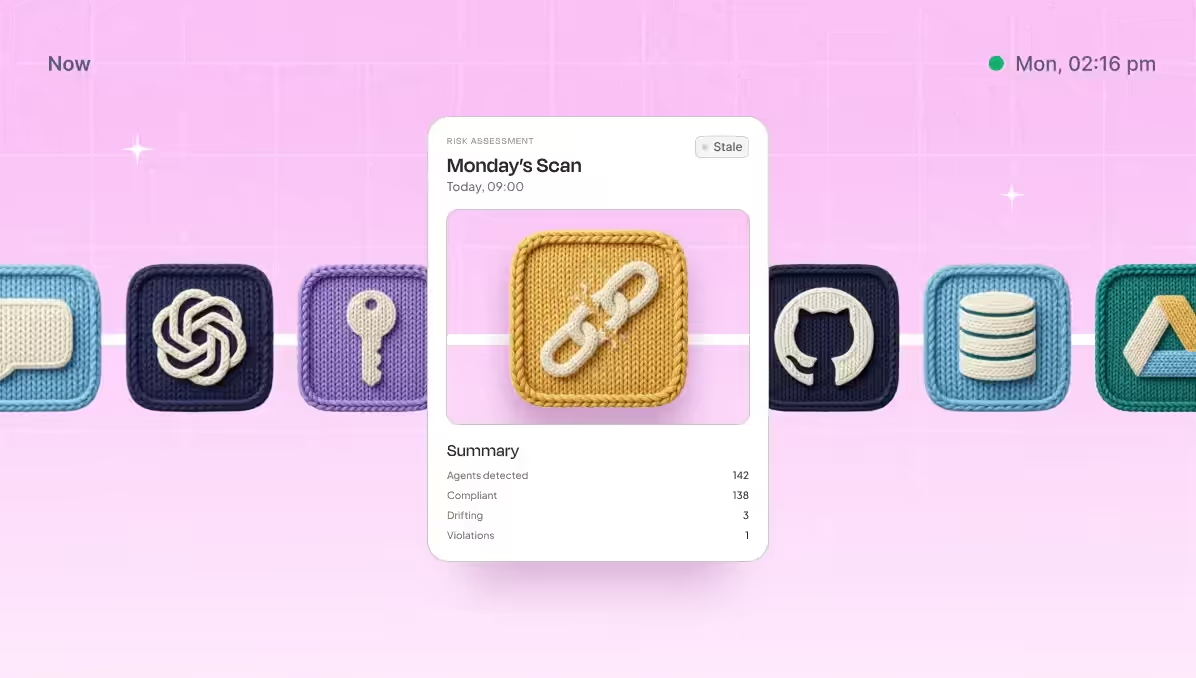
Continuous posture monitoring is the current state of the entire AI environment, across all agents, against all policies, right now. For example, it tells you “as of this moment, you have 142 agents in production, 138 are compliant with policy P-04, 3 are in a drift state pending review, and 1 has been operating outside its authorized tool set for the last 27 minutes.”
Both are necessary. They are not the same thing. An organization can have excellent event alerting and zero continuous posture visibility, and most enterprises with significant AI agent deployments are exactly there today. The CISO can describe what went wrong yesterday but cannot describe the current state of the environment without spinning up a manual aggregation across three or four systems.
The Four Components of AI Continuous Posture
Real-time agent inventory. The agents that exist right now, not the ones that existed at the last scan. Including the ones that were not formally approved.
Live policy compliance status. Which agents are currently compliant, which are drifting, which are in violation. Continuously updated, not snapshot at the moment of a scan.
Configuration-drift visibility against approved policy. Which agents have had their configuration, permission set, or tool access changed since the last approved baseline. This is the slowest-moving signal but often the most consequential; the agent whose permissions expanded over six weeks through a chain of approved exceptions is the one that does not trip event alerts and does not appear in a one-time scan.
An accurate real-time view. This is the operational benchmark, and it is harder than it sounds. The platforms most enterprises are using to assemble their AI risk view rely on scheduled scans, manual aggregation, or backward-looking dashboards. The view is “as of last Friday at 3 PM.” The continuous posture view is “as of right now.”
The benchmark for mature AI risk governance is one question
An organization that can answer “what is our AI risk at this very moment?” without running a report, without waiting for a scan, without aggregating spreadsheets from multiple systems, has continuous posture visibility.
Most organizations today cannot answer that question on demand. Decisions and policies are operating on snapshots, while the AI agents are running a video.
This is one of the primary AI Security gaps, when the agent actor runs faster than the reporting cycle. Legacy controls are almost completely blind, and most existing AI controls cannot log, analyze and act upon agent reasoning and behavior before action occurs.
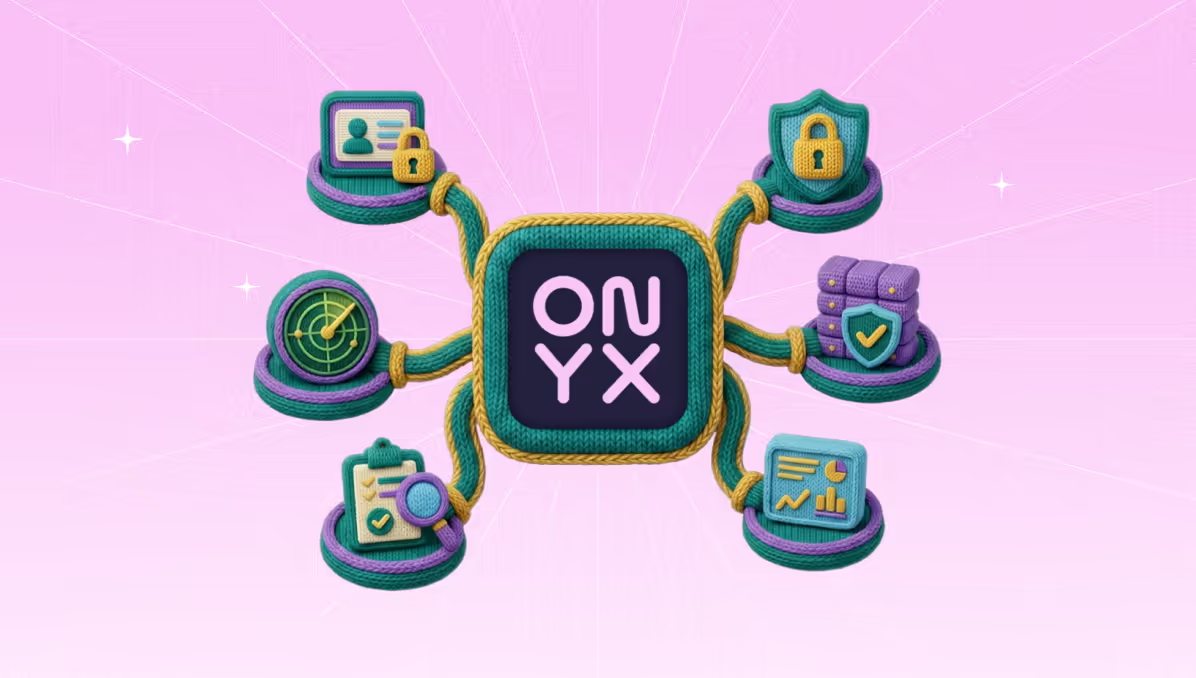
Onyx provides the continuous posture view this post describes: real-time agent inventory, policy compliance monitoring, configuration-drift detection against approved policy, and posture management across your agent fleet that updates as your fleet changes, not as your reporting cycle turns. If you want to see what your AI risk looks like in real time rather than in retrospect, book an architecture assessment.
Frequently Asked Questions
Continuous AI posture management is the ability to see the current state of an entire AI environment – across all agents, against all policies – in real time. Unlike periodic risk reports or scheduled scans, continuous posture provides a live view of agent inventory, policy compliance status, configuration drift, and risk exposure as conditions change, not weeks later.
Event alerting is reactive and specific – it fires when a violation occurs and identifies the agent, action, and policy involved. Continuous posture monitoring provides the current compliance state of every agent across every policy simultaneously. An organization can have excellent event alerting and zero continuous posture visibility, leaving CISOs unable to describe the environment's real-time risk without manual aggregation.
Configuration drift detection continuously compares each AI agent's current permissions, tool access, and configuration against its last approved baseline. This catches gradual, often-approved changes – such as an agent whose permissions expanded over six weeks through a chain of exceptions – that do not trigger event alerts and do not appear in periodic scans but carry significant cumulative risk.
AI agents run thousands of sessions daily, meaning risk posture can shift meaningfully within hours. Quarterly or even weekly reporting cycles produce stale data – by the time a CISO presents to the board, the picture is already a quarter behind. Real-time AI posture management eliminates that gap, letting leaders answer what AI risk is right now.
Enterprises should assess whether a platform delivers four core capabilities: real-time agent inventory including unapproved agents, live policy compliance status updated continuously, configuration-drift visibility against approved baselines, and an accurate real-time operational view. Platforms relying on scheduled scans, manual aggregation, or backward-looking dashboards cannot provide the continuous posture visibility mature AI governance requires.