Glean is fast becoming a preferred solution to help employees find company knowledge, get answers, and automate work through AI-powered search, assistants, and agents connected to enterprise data and applications. However, most companies are not prepared to manage agents and the risks associated with rapid AI transformation. Security teams need to continuously understand what agents can access, what actions they can take, and whether they remain within policy. They also need to intervene when external attackers manipulate agents, employees use AI in unauthorized ways, or agents take unintended actions.
To this end, Onyx and Glean are announcing a partnership to help enterprises put AI agents to work with the visibility, governance, and runtime protection needed to scale adoption. Onyx is proud to be selected as one of Glean’s security partners, supporting a shared commitment to secure enterprise AI adoption.
Glean’s Work AI platform provides the enterprise context and platform to build, deploy, and operate enterprise AI agents. Onyx provides the unified control layer for AI usage across the entire customer environment. Together, we help security teams understand which agents are operating, what they can access, and whether their actions remain aligned with user intent and enterprise policy.
For enterprises expanding from a few AI use cases to agents working across departments, the partnership helps reduce governance friction and provides robust runtime controls. Security teams gain a repeatable governance process supported by automation, which can move Glean deployments into production faster and provide centralized visibility across the broader agent ecosystem.
Why enterprise context and runtime control belong together
Glean connects agents to the enterprise knowledge and business systems they need to perform useful work, enforcing its native access permissions. Onyx adds security policy checks at supported checkpoints, evaluating conversation content and proposed tool executions against enterprise AI policies as the workflow progresses.
Consider an account team asking an agent to prepare for a customer renewal. Glean enforces native access permissions when the agent retrieves account records, support tickets, and internal discussions. At a supported tool-execution checkpoint, Onyx can check a proposed action—such as sending internal pricing guidance to an external recipient—against enterprise policy and block it if it violates that policy.
Together, Glean and Onyx help enterprises govern both access to information and its use in agent workflows. Glean provides permission-aware enterprise context, while Onyx adds a purpose-built AI control layer that complements Glean’s native safeguards and extends across the broader enterprise AI environment.
How Onyx and Glean work together
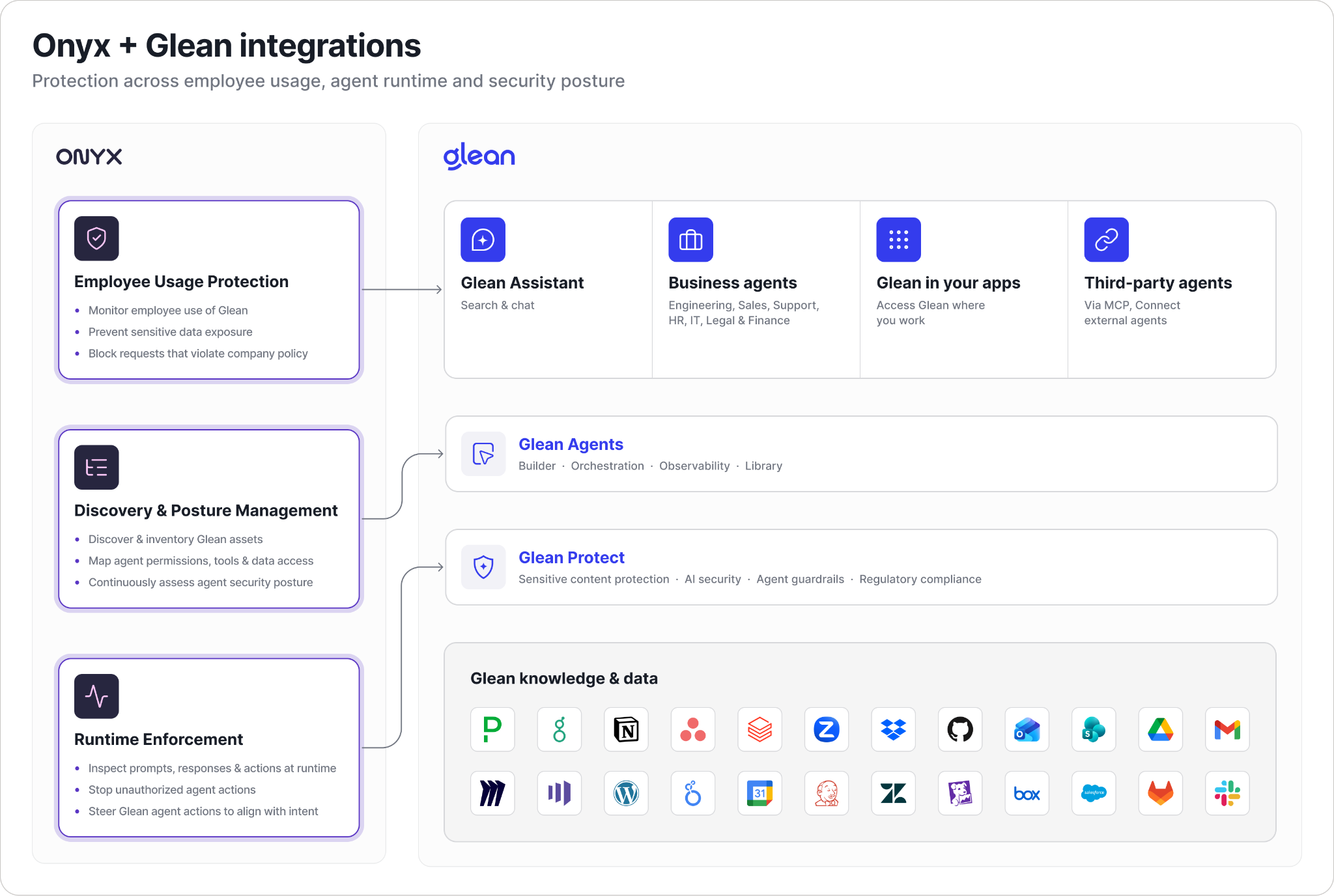
Onyx complements Glean Protect, Glean’s built-in security foundation, by adding a purpose-built AI control layer for governance and security. Glean Protect secures Glean’s platform and access layer, including native permissions enforcement, SSO, RBAC, encryption, audit logs, and compliance controls. Onyx builds on that foundation with enterprise-wide agent discovery, governance, and intent-aware runtime controls, helping security teams apply consistent policies across Glean and the broader AI environment.
Onyx uses the Glean API for read-only discovery of agent inventory and posture, helping security teams understand agents and their associated access and capabilities. Glean’s runtime hooks provide checkpoints for Onyx to evaluate conversation content and tool executions against enterprise AI policies.
That connects governance to the work agents are performing. Security teams can establish ownership and business purpose, classify risk, and continuously assess changes to permissions, tools, and data access. At runtime, Onyx evaluates prompts, responses, and proposed actions to block malicious requests and steer unintended behavior toward a policy-compliant outcome. Onyx can also identify and block out-of-policy employee use of Glean Assistants in the browser.
Glean’s native permissions and security controls remain part of that architecture. Onyx adds a common governance and runtime policy layer across Glean and the other AI platforms, applications, and agents the enterprise uses.
Automate a repeatable governance process
A useful agent can stall before deployment when security teams cannot establish who owns it, what business purpose it serves, or which policies apply. Repeating that review from scratch for every new agent makes it difficult to expand adoption.
For example, an employee onboarding agent might answer policy questions and help new hires find internal resources. Before approving it, security needs to understand its connected sources, access, and intended actions. If the agent later gains a tool that can update employee records, its risk profile changes.
Glean and Onyx support a repeatable governance process built around documented ownership, business purpose, risk classification, and enterprise policies. Automated assessments help teams apply consistent approval criteria and identify changes in permissions, tools, and data access that warrant further review. This reduces manual review effort and governance friction, helping valuable Glean deployments reach production faster while security maintains oversight as use cases expand.
See Glean agents alongside the rest of enterprise AI
A large enterprise may use Glean agents for knowledge work, coding agents for software development, and custom agents for internal operations. Security teams need to understand the relationships between those environments and the access they create.
Glean provides visibility into the agents built and operated on its platform. Onyx combines that intelligence with discovery across other AI environments, giving security teams centralized visibility across the broader agent ecosystem. A unified inventory brings agent owners, access, capabilities, and risk into one view, helping teams assess Glean alongside third-party copilots, custom agents, and cloud AI services.
If several agents across different platforms can access sensitive customer information, security can assess that exposure together and apply a common policy. Centralized audit evidence also helps teams explain how AI is governed across the organization, with less effort spent reconciling separate platform records.
Keep AI usage and agent actions within policy
Agent risk also changes during a session. A legitimate request can lead an agent to encounter malicious instructions in retrieved content or to take an action that goes beyond what the user intended.
Consider a support agent asked to summarize a customer’s open issues. A retrieved ticket might contain a prompt injection directing it to export customer records to an external destination. Onyx can evaluate that request against enterprise policy and block the malicious activity at runtime.
Employee misuse introduces another risk, whether deliberate or inadvertent. An employee might have legitimate access to customer records but ask an agent to compile and send those records to a personal email address. The agent could follow that instruction exactly while violating enterprise data-handling policy. Onyx evaluates the request and proposed action against company policy and can block unauthorized activity before execution. This helps enterprises govern how employees use the information they can access, alongside Glean’s native permissions controls.
Misalignment can also occur. The same request to summarize issues could lead it to propose closing tickets or changing their priority. Onyx evaluates user intent and agent reasoning to identify that departure and steer the agent back toward the authorized task.
These illustrative workflows show why runtime control matters: enterprises need to evaluate what an agent is about to do in the context of the work it was asked to perform. That allows intervention before an unsafe action creates business impact.
A consistent foundation for expanding AI adoption
As enterprises deploy more Glean agents and connect them to additional systems, the governance model needs to follow that expansion. Ownership and risk classification established during approval should inform runtime policy, while changes in access and behavior should feed back into ongoing assessment.
Our partnership with Glean helps connect those stages. Glean gives employees the enterprise context and agent platform to accomplish work. Onyx gives security teams a unified way to govern that activity alongside the rest of enterprise AI. The Onyx Secure AI Control Plane is available on the Glean Connector hub.
To explore how Onyx can support your organization’s AI security and governance requirements for Glean, contact us for a demo.
Frequently Asked Questions
The partnership combines Glean’s enterprise context and agent platform with Onyx’s Secure AI Control Plane. Security teams can discover agents, assess their access and risk, automate governance reviews, and apply runtime policies at supported checkpoints, helping Glean deployments reach production faster while maintaining oversight.
Glean Protect provides Glean’s native security foundation, including permissions enforcement, SSO, RBAC, encryption, and audit logs. Onyx adds enterprise-wide agent discovery, automated governance, and intent-aware runtime controls. This helps enterprises govern how information is used in agent workflows and apply consistent AI policies across Glean and other environments.
Onyx uses the Glean API for read-only discovery of agent inventory and posture, helping teams assess ownership, permissions, tools, and data access. Automated assessments flag changes that warrant review. Through Glean’s runtime hooks, Onyx evaluates prompts, responses, and proposed tool executions at supported checkpoints to block policy violations and steer unintended actions toward the authorized task.
Onyx helps protect against external attackers, employee misuse, and unintended agent behavior. This includes prompt injections in retrieved content, requests to share sensitive information with unauthorized recipients, and agent actions that exceed the user’s intended task. Onyx evaluates activity against enterprise policy and user intent to intervene before unsafe actions create business impact.
Yes. Onyx brings Glean agent inventory and risk information into the same Secure AI Control Plane used across other supported AI environments. Teams gain centralized visibility, common governance policies, and consolidated audit evidence across Glean, third-party copilots, custom agents, and cloud AI services.